
What Does Success Look Like?
What Does Success Look Like?
Before we begin teaching the practical skills, it is important to define what we mean by walking nicely on a loose leash and establish realistic goals for both dogs and their guardians.
When many people think about leash walking, they picture an obedience-style heel position, where the dog walks precisely beside the handler's leg and maintains that position throughout the walk. That is not the goal of this program.
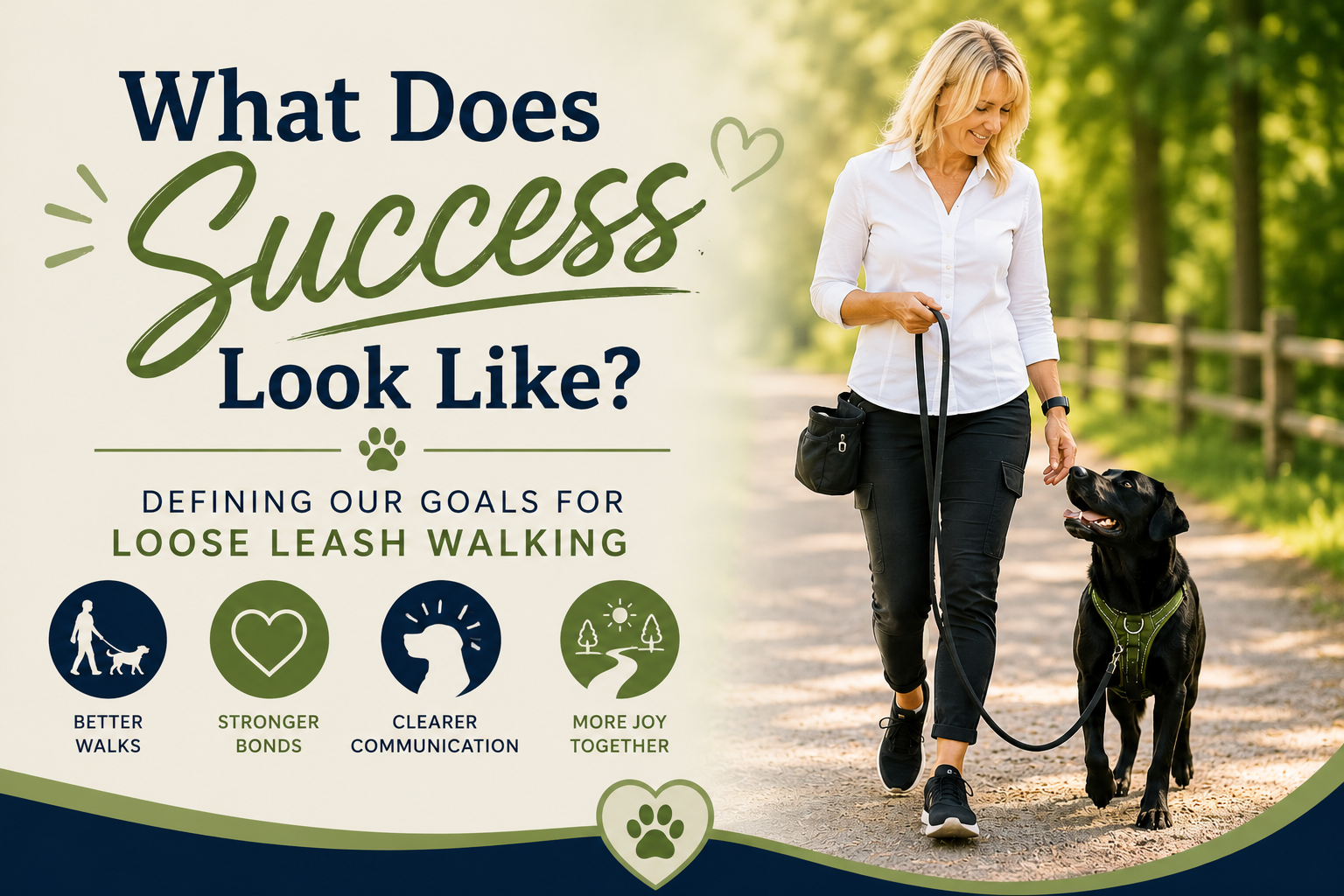
Our goal is for the dog and guardian to move together comfortably and safely, with neither party creating tension on the leash. A dog walking on a loose leash may be beside the guardian, slightly ahead, or slightly behind, provided the leash remains slack and both dog and guardian are able to enjoy the walk together.
Loose leash walking is not simply about preventing pulling. It is about developing communication, cooperation, and shared enjoyment. It is a life skill that helps dogs and guardians navigate the world together while reducing frustration for both ends of the leash.
What We Hope Guardians Will Achieve
By the end of this program, guardians should have the knowledge and practical skills needed to:
- Teach their dog to walk on a loose leash without pulling.
- Respond effectively if their dog begins to pull or surge forward.
- Avoid unintentionally creating leash tension themselves. Yes, humans pull too!
- Understand how to continue practising and strengthening the skills learned throughout the program.
- Generalize leash walking skills to a variety of locations and environments.
- Communicate more clearly with their dog.
- Increase their dog's attention and engagement during walks.
- Improve their own awareness of their dog's needs, emotions, and communication.
- Build a stronger relationship with their dog through shared training experiences.
- Enjoy walks that are calmer, more rewarding, and more enjoyable for both dog and guardian.
Most importantly, we hope that both dog and guardian will look forward to spending time together and that walks become a highlight of the day rather than a source of frustration.
Understanding the Training Journey
Like all complex behaviors, loose leash walking is built gradually through a series of small, achievable steps.
The journey begins with something very simple: teaching the dog how to stand on a loose leash without creating tension.
From there, the dog will learn to move with the guardian over short distances in low-distraction environments. During some of the early exercises, the guardian may even be walking backward. Don't worry - this is a normal and important part of the learning process!
As skills develop, both dog and guardian will learn how to move together while maintaining a loose leash. By the end of the program, the goal is for the dog to comfortably walk near the guardian for at least 20 dog lengths without either the dog pulling the guardian or the guardian pulling the dog.
The leash should remain loose, communication should remain clear, and both dog and guardian should feel successful.
Beyond the Program
The end of this program is not the end of the learning journey.
The ultimate goal is to remove the strain from both the leash and the walk itself, creating enjoyable outings that enrich the lives of both dog and guardian. With continued practice, thoughtful progression, and opportunities to generalize skills in new environments, loose leash walking can become a reliable and rewarding part of everyday life.
Additional proofing, maintenance, and generalization strategies can be found in the 10 Steps to Walking Nicely on a Loose Leash E-Workbook.