
Introducing the 10-Step Training Plan
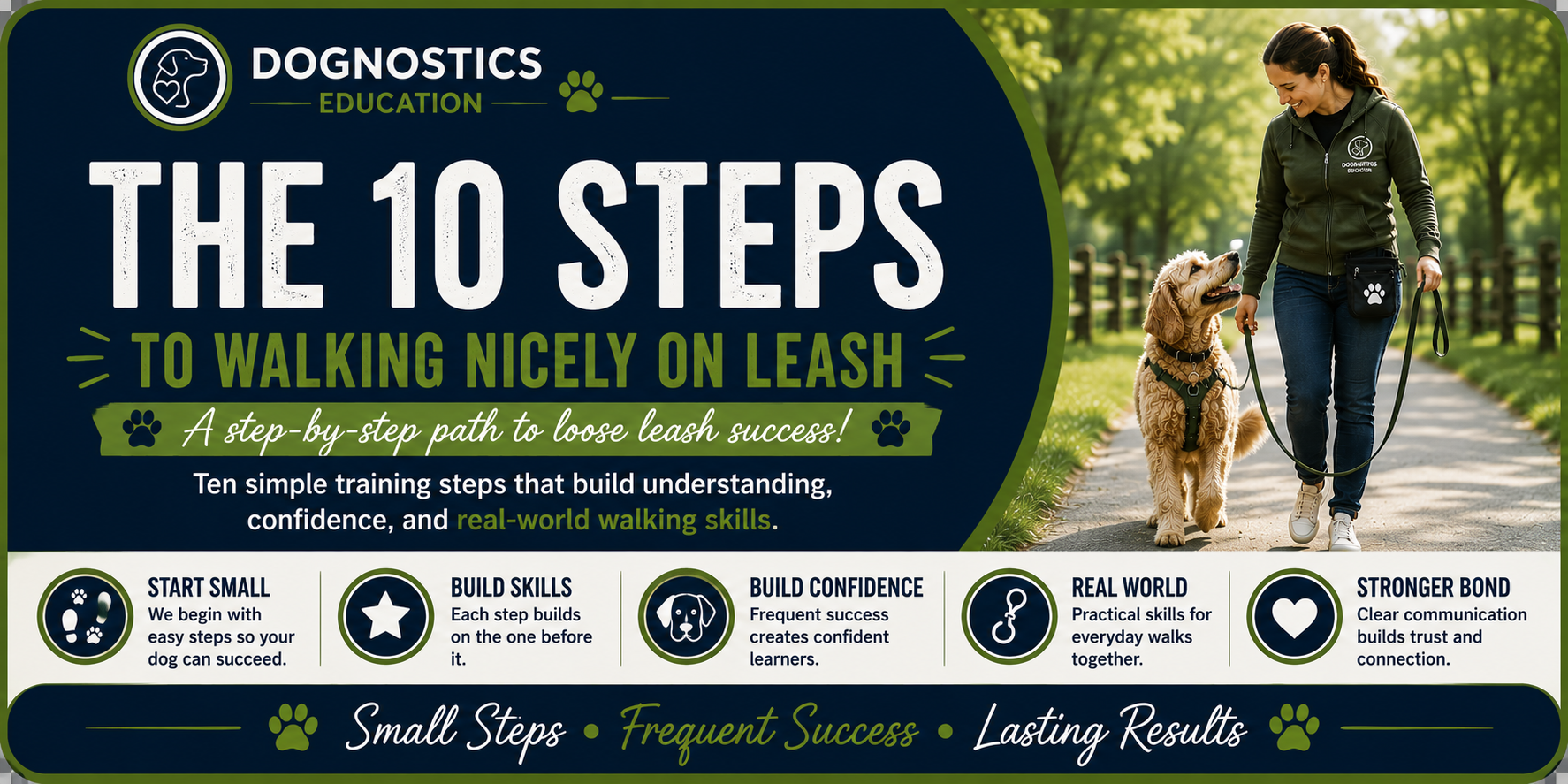
The following ten training steps form the heart of the 10 Steps to Walking Nicely on a Loose Leash program.
Together, they provide a simple, systematic, and highly achievable pathway from standing still with a loose leash to walking successfully alongside a guardian in real-world environments.
Each step builds directly upon the skills developed in the previous step. Rather than asking dogs to learn loose leash walking all at once, we break the skill into a series of small, manageable pieces that allow both dog and guardian to experience frequent success.
This progressive approach helps build confidence, clarity, and understanding while reducing frustration for both ends of the leash.
Why We Teach the Skills in This Order
One of the most common mistakes made when teaching loose leash walking is progressing too quickly.
Guardians often begin by expecting dogs to walk for long distances while maintaining a loose leash despite distractions, exciting environments, and competing motivations.
For many dogs, this is simply too difficult.
Instead, this program begins with extremely low criteria and gradually increases the level of difficulty.
We start by reinforcing:
- A single step.
- A few steps.
- Small changes of position.
- Short periods of walking together.
Only when those skills become reliable do we ask for more.
Each new step builds upon previously learned behaviors, allowing the dog to experience a high rate of success throughout the learning process.
Small Steps Create Big Results
The goal of this program is not perfection.
The goal is understanding.
When dogs understand what is expected of them and have a long history of reinforcement for making good choices, loose leash walking becomes easier, more reliable, and more enjoyable.
Many guardians are surprised by how small some of the early training steps appear.
Please encourage them to trust the process.
Those small early successes create the foundation for the more advanced skills that follow.
As we often say:
Slow is smooth. Smooth is fast.
Taking the time to build a strong foundation usually results in faster overall progress.
The Train-Test-Train Method
Throughout the program, we continue to use the Train-Test-Train Method introduced earlier.
This ensures that progression is based on the dog's performance rather than on a predetermined timeline.
Remember:
- PUSH when the dog is succeeding.
- STICK when more practice is needed.
- DROP when the criteria have become too difficult.
Every dog progresses at their own pace.
There is no prize for reaching Step 10 quickly.
The real goal is long-term success.
Written Skill Descriptions
The written training instructions included in this section are taken directly from the Pet Dog Guardian E-Workbook.
The material is written specifically for pet dog guardians and is provided here as a reminder of the information your clients will receive.
All text remains subject to copyright.
The E-Workbook may be downloaded and shared with your clients as part of your use of this Professional Tool-Kit. Please do not copy and paste the workbook text directly from this section of the course.
Training Videos
Each training step is accompanied by a short instructional video.
These videos are available for you to download and share directly with your clients.
Many professionals find that the videos help reinforce learning between sessions and provide valuable homework support for guardians.
Watching the exercises demonstrated often helps clients better understand the mechanics of training and increases consistency between lessons.
Using the Training Steps Within Your Business
If you are delivering a six-class course, we recommend sharing each step according to the schedule outlined in the accompanying 6-Class Curriculum.
This allows guardians to practice one stage at a time and prevents them from progressing too quickly.
Alternatively, you may choose to incorporate the material into:
- Private training sessions.
- Day training programs.
- Pet care services.
- Puppy training programs.
- Pet dog manners classes.
- Specialty loose leash walking classes.
Regardless of how you choose to deliver the material, the steps should always be introduced in sequence.
Each skill has been designed to prepare the dog and guardian for the next stage of learning.
Skipping ahead may reduce understanding and make success more difficult to achieve.
Key Takeaway
The success of this program lies not in any single training step, but in the way each step builds upon the last.
Trust the process, progress at the dog's pace, and celebrate the small successes along the way.
