
The Language of Modern Dog Training
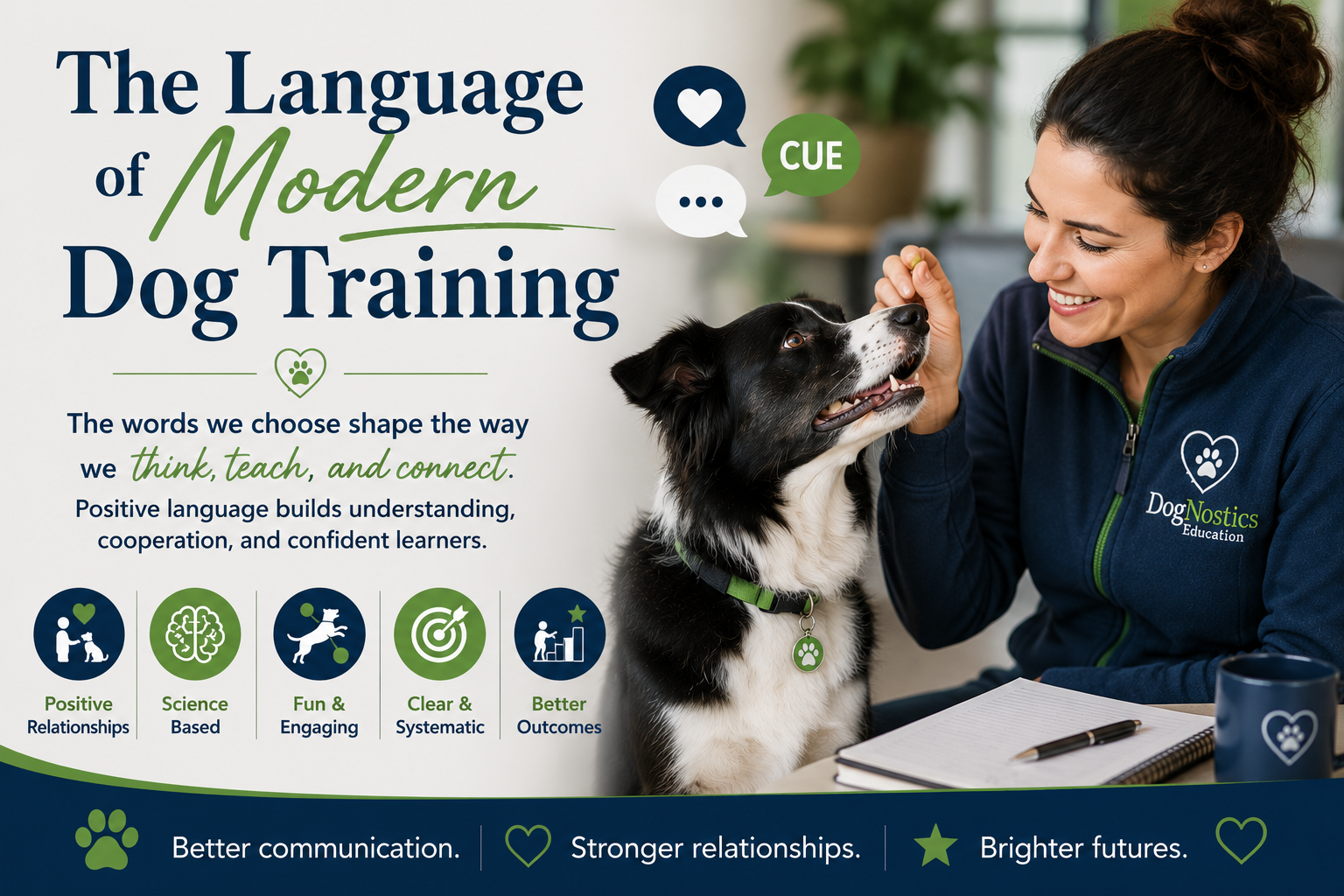
The Language of Modern Dog Training
Throughout the DogNostics Dog Trainer Certification Program, you'll hear us use words and phrases that may be different from those you've previously encountered.
That is entirely intentional.
Language shapes the way we think, the way we teach, and ultimately the way we interact with the dogs and people we work with. Many of the traditional terms that have been used in dog training for decades originated from a very different philosophy - one based on control, compliance, and obedience.
Modern, evidence-informed, force-free training reflects a different philosophy. It recognizes dogs as sentient learners rather than animals that need to be dominated or controlled. As our understanding of animal learning, cognition, emotion, and welfare has evolved, so too has the language we use.
Throughout this program, you'll see those principles reflected not only in the way we teach, but also in the words we choose.
Why We Talk About Games, Tricks, and Skills
One of the first things you'll notice is that we often refer to training games, tricks, and skills.
We're usually talking about exactly the same behaviors.
Whether we're teaching a puppy to sit politely, a reliable recall, cooperative veterinary care, a service dog task, or an advanced trick, the underlying learning principles remain the same.
Calling training a game doesn't make it any less professional or less important.
In fact, quite the opposite.
Games encourage us to think about creating an enjoyable learning experience rather than simply achieving an outcome.
Our goal is not simply to produce reliable behavior. Our goal is to produce reliable behavior while maintaining enthusiasm, confidence, and a positive emotional experience for the learner.
Training should be systematic, achievable, and successful - but it should also be enjoyable.
For the dog.
For the trainer.
And for the people who live with that dog.
Happy Dogs Create Happy Clients
As professionals, we sometimes become so focused on teaching skills that we forget something equally important.
Our clients are watching.
When guardians see their dogs eagerly running to training sessions, wagging their tails, offering behaviors enthusiastically, and genuinely enjoying the process, something wonderful happens.
They become excited about training too.
Training no longer feels like homework.
It becomes something they look forward to doing together.
Not only do they see their dog's manners improving, but they also see their dog becoming more confident, more engaged, and enjoying valuable mental and physical enrichment at the same time.
Clients who enjoy training are far more likely to continue practicing between sessions, complete homework assignments, and remain committed to the learning process.
Everyone wins.
Skills That Matter in Real Life
Some people mistakenly think that "games" only refer to novelty tricks.
Nothing could be further from the truth.
Many of the games you'll learn throughout this program teach life-changing skills, including:
- Reliable recalls
- Leave It
- Loose leash walking
- Cooperative veterinary care
- Husbandry behaviors
- Service dog foundation skills
- Family manners
- Emotional resilience
- Confidence
- Problem solving
These are serious, valuable life skills.
We simply choose to teach them in ways that are enjoyable for the learner.
Why We Prefer Cues Rather Than Commands
You will also notice that we use the word cue rather than command.
A command implies that obedience is expected.
A cue is simply information.
It tells the dog which behavior is likely to be reinforced.
Rather than demanding compliance, we create an environment in which the dog understands what is being asked and is motivated to participate.
The difference may seem subtle, but it reflects a profound shift in philosophy.
Our goal is not blind obedience.
Our goal is willing cooperation.
We Don't Train Dogs to Obey
Historically, dog training often focused on obedience.
Today, many force-free professionals prefer to talk about teaching life skills, manners, cooperative behaviors, or everyday skills.
The distinction is important.
We're not trying to suppress a dog's behavior or force compliance.
We're helping dogs learn how to succeed in the environments in which they live while preserving their confidence, welfare, and ability to make good choices.
Why We Don't Talk About "Pack Leaders"
You'll also notice that we don't use terms such as pack leader, alpha, or pack hierarchy.
These concepts originated from early captive wolf studies conducted many decades ago. Subsequent research has shown that these studies do not accurately represent either wolf family groups in the wild or domestic dogs living with people.
Modern behavioral science tells us that our relationships with dogs are not based on dominance or hierarchy.
Instead, they are built on trust, communication, reinforcement, predictability, and cooperation.
That's why you'll hear us refer to:
- our canine friends
- our canine family members
- our canine companions
- our canine clients
And when talking about our own dogs, many of us affectionately say:
- fur kids
- canine kids
- family members
Likewise, we would refer to a group of dogs not a pack.
These choices aren't about political correctness.
They're about using language that reflects what current science tells us about dogs and the relationships we share with them.
A Philosophy That Runs Throughout This Program
As you progress through the Apprentice, Journeyman, and Master levels, you'll find that the language we use reflects the philosophy we teach.
We believe training should be:
- Evidence-informed.
- Ethical.
- Force-free.
- Systematic.
- Clear.
- Achievable.
- Enjoyable.
- Enriching.
Our aim is to help dogs become enthusiastic learners, guardians become confident teachers, and professionals build rewarding careers based on kindness, compassion, and sound scientific principles.
Because when learning is enjoyable, everyone succeeds.